
Size
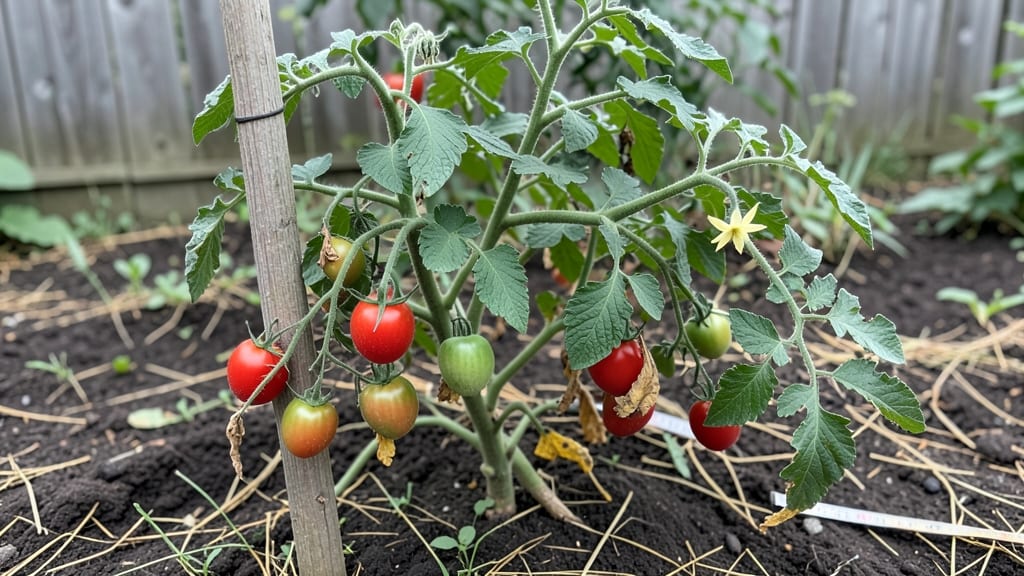
Your garden’s vertical potential depends entirely on the tomato type you choose—determinate varieties stay compact, while indeterminate types can climb like jungle vines if given the right conditions. 🌱 The key difference lies in their growth habits: determinate plants set all their fruit at once and cap growth at 3-5 feet, whereas indeterminate plants keep producing until frost and can sprawl 6-12 feet without intervention.
This genetic trait explains why cherry tomatoes often need cages while beefsteaks demand sturdy trellises.
Support isn’t just about height control—it’s about fruit quality and yield. When plants sprawl uncontrolled, they’re more prone to disease and sun scorch, while proper pruning redirects energy to fewer, larger fruit.
I’ve seen ‘Big Beef’ tomatoes double their production just by removing suckers and training vines upward. The right support system turns a wild tangle into a productive, manageable harvest tower.
💡 In This Article
- Tomato Plant Height Variations by Type
- Maximizing Tomato Plant Growth with Pruning and Support
Tomato plant height variations by type
Here's what's actually happening at the genetic level: tomato plants fall into three distinct growth categories, each with hardwired height limits determined by their DNA. Determinate varieties—like 'Roma' or 'Celebrity'—produce a single flush of fruit before stopping growth, capping height at 3-5 feet.
This is because their apical meristem (growth tip) naturally terminates after flowering, a trait controlled by the SEPALLATA genes that regulate flower development. Indeterminate types, however, have an active apical meristem that keeps growing until frost, allowing vines to reach 6-12 feet or more.
The science behind this involves plant hormones, particularly auxin and ethylene. Determinate plants produce more ethylene at the growth tip, which signals the plant to stop elongating.
Indeterminate varieties maintain lower ethylene levels, letting auxin continue driving vertical growth. 🌱 This hormonal difference explains why 'Sungold' cherry tomatoes can climb indefinitely while 'Better Boy' beefsteaks need constant pruning to manage their sprawl.
Semi-determinate types (like 'Mountain Merit') sit in the middle, producing multiple fruit clusters before slowing growth.
What most people don't realize is how these growth habits affect fruit production. Determinate plants concentrate energy into a single harvest, yielding 50-100 tomatoes per plant all at once, while indeterminate plants produce continuously but with 20-40 fruit per vine.
The trade-off is why dwarf varieties like 'Tiny Tim' (just 12-18 inches tall) work perfectly for containers but produce smaller yields than their taller counterparts.
This genetic programming means your garden layout should match the variety—determinate plants thrive in cages, while indeterminate types need vertical support like 6-foot stakes or trellises.
Environmental factors can push these limits even further. In ideal conditions (full sun, rich soil, consistent water), indeterminate 'Cherokee Purple' vines have reached 15 feet in commercial greenhouses. However, in home gardens, they typically max out at 8-10 feet due to space constraints.
The key factor is pruning—removing suckers (side shoots) redirects energy upward, while letting them grow wild creates bushy plants that may reach similar heights but with poor fruit quality. 🌿 This is why professional growers use a technique called "topping" to control height in commercial indeterminate varieties.
Consider these growth patterns when selecting varieties for your space. Dwarf tomatoes (1-3 feet) work for balconies, while standard determinate types (3-5 feet) fit raised beds. Indeterminate varieties need 5-10 feet of vertical space, making them ideal for trellises or tall cages.
The right choice depends on your growing conditions—container gardens limit height, while ground planting encourages sprawl. Understanding these genetic differences lets you optimize both space and yield in your garden.
Here's a practical tip: if you love heirloom tomatoes like 'Brandywine' (indeterminate, 5-8 feet), start training vines early. Use soft ties at 2-3 feet intervals to prevent wind damage, and prune aggressively to maintain airflow—this reduces disease while maximizing height potential.
The payoff? Healthier plants that produce fruit all season long. 💫