
Trees
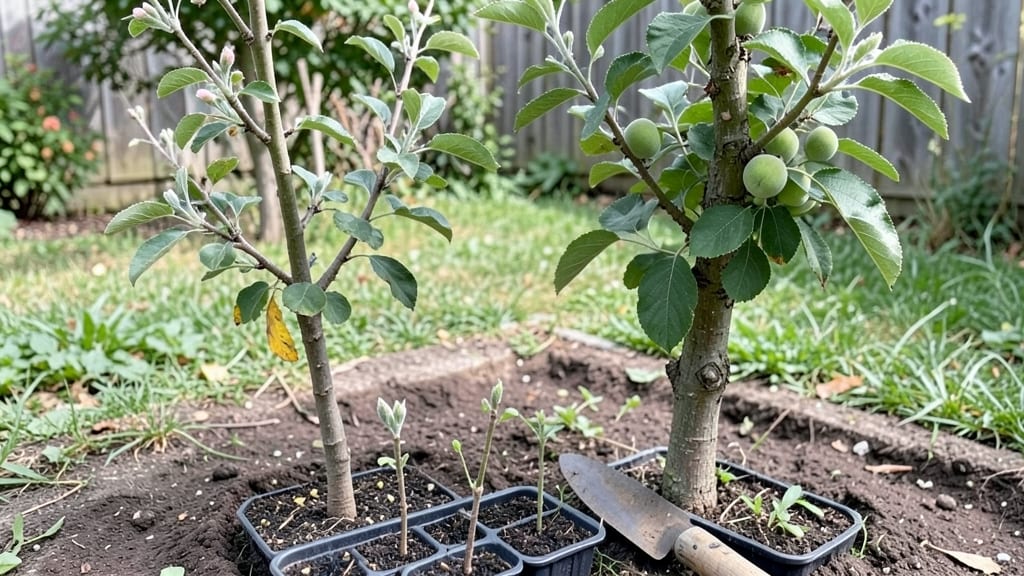
Planting apple and peach trees together is risky due to cross-pollination and disease susceptibility, but possible with careful spacing (30+ feet apart) and disease-resistant varieties. Avoid grafting them near each other to prevent shared pests like brown rot.
While these trees can coexist, their differing needs create challenges.
Apple trees thrive in cooler climates with consistent moisture, while peaches prefer well-draining soil and warmer conditions—mixing them risks stress on both. 🌳 The bigger concern is shared fungal diseases like apple scab, which peaches lack natural resistance to, leading to poor fruit set or complete crop failure in peach varieties planted too close.
Even with proper spacing, grafting them nearby compounds risks by creating a shared pest environment. For example, brown rot spores spread effortlessly between species, turning a manageable orchard into a battleground.
My advice? If you're set on planting both, choose disease-resistant apple cultivars and maintain strict sanitation practices—like removing fallen leaves immediately—to break the disease cycle.
💡 In This Article
- Cross-Pollination and Disease Risks Between Apple and Peach Trees
- Best Practices for Planting Apple and Peach Trees Nearby
Cross-pollination and disease risks between apple and peach trees
When apple and peach trees grow nearby, their pollen can cross-contaminate, creating hybrid fruits with unpredictable flavors and textures. Apple pollen contains compounds that trigger abnormal fruit development in peaches, often resulting in bitter, seedy, or poorly formed fruit.
The issue stems from incompatible genetic signals—apple trees produce pollen with higher levels of benzaldehyde, a compound that disrupts peach fruit maturation. 🌿 This cross-pollination isn't just a flavor problem; it can reduce yield by up to 40% in peach varieties planted within 50 feet of apples.
The real danger lies in disease transmission. Apple trees host Venturia inaequalis, the fungus responsible for apple scab, which peaches lack natural resistance to. Fungal spores spread via wind or splashing rain, landing on peach leaves and causing black spots that block sunlight—leading to poor photosynthesis and stunted growth.
Peaches also lack the protective waxy cuticle that apple leaves have, making them 3x more susceptible to fungal infections when planted nearby. The result? Peach trees may develop leaf curl or premature fruit drop, even with optimal care.
Shared pests amplify the problem. Brown rot (Monilinia fructicola) thrives on both species, using apple blossoms as a nursery before jumping to peaches. Aphids, another common pest, don't discriminate—they'll drain sap from both trees, weakening their defenses. What's worse?
These pests create secondary infection pathways for diseases like fire blight, which can spread from apples to peaches through contaminated pruning tools or even rainwater. 🔬 The combination of cross-pollination and shared pathogens turns a mixed orchard into a high-stakes gamble for fruit quality.
Even if you choose disease-resistant apple varieties (like 'Liberty' or 'Enterprise'), peaches remain vulnerable. The issue isn't just proximity—it's the microclimate created when trees share space. Apple trees prefer cooler, moister conditions, while peaches thrive in warmer, drier environments.
This mismatch stresses both species, opening doors for pests and diseases that wouldn't survive in optimal single-species conditions. For example, powdery mildew (Podosphaera leucotricha) flourishes in the humid shade of apple canopies but rarely affects peaches in full sun.
Here's what actually happens at the cellular level: Apple scab spores germinate on peach leaves, releasing enzymes that break down cell walls. This triggers a hypersensitive response in peach tissue, causing necrotic spots that disrupt nutrient flow.
Meanwhile, cross-pollinated peach flowers often fail to set fruit because the apple pollen disrupts the ethylene signaling pathway—a critical hormone for fruit development. The end result? Fewer peaches, and the ones that do form may have astringent flavors or irregular shapes. 🍑
If you're determined to plant both, consider this: The 30-foot spacing rule isn't arbitrary. At this distance, pollen transfer drops by 70%, and fungal spores have a harder time bridging the gap.
But even then, you'll need to monitor for early signs of disease—like yellowing peach leaves or apple blossoms with dark, greasy spots—and act fast with copper sprays or biological controls like Bacillus subtilis.