
Propagation
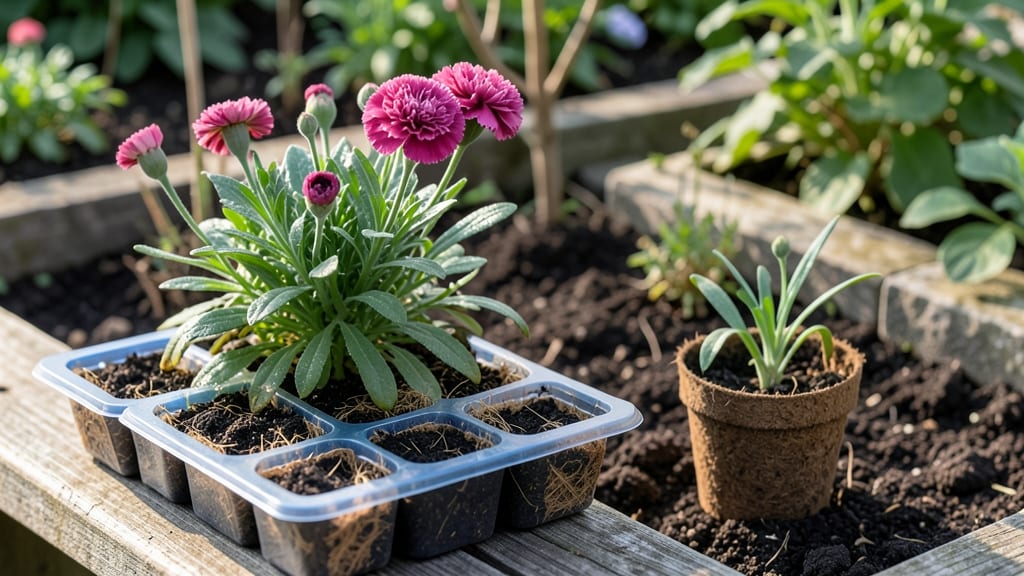
Planting carnation seeds gives you a head start on those fragrant, long-stemmed blooms you’ll be snipping in just 8-10 weeks—if you follow the right tricks. I’ve struggled with slow germination before, but once I adjusted the soil temperature and light, my seedlings popped up in under a week.
The secret isn’t just patience; it’s creating the perfect cozy conditions they crave.
You’ll need a shallow tray, well-draining potting mix, and a heat mat or sunny windowsill—no fancy equipment. Carnations want their seeds sown just ¼ inch deep and spaced ½ inch apart, with consistent moisture but no soggy soil.
Overwatering is the #1 killer of tiny carnation sprouts, so a spray bottle works better than a watering can. Think of it like raising a picky baby: gentle care, not smothering.
Within days, you’ll spot those first tiny green hooks breaking through the soil, and by week 3, you’ll be pinching back leggy seedlings to encourage bushier growth. The payoff? Clusters of vibrant blooms that last weeks in vases or straight from the garden.
Just avoid the common mistake of transplanting too early—wait until seedlings have 3-4 true leaves before moving them outdoors.
This method works for both garden borders and container growing, so whether you’ve got a full sun patch or just a sunny windowsill, you can grow carnations. The key is consistency: keep the soil warm, the light bright, and the watering steady.
Once you’ve got your first batch of blooms, you’ll be hooked on starting from seed!
📚 In This Guide
- What you need
- Instructions
- Tips and common mistakes
- Wrapping up and next steps
What you need
- ● Carnation seeds: 1–2 packets (50–100 seeds per packet, depending on variety)
- ● Pro tip: Choose heirloom or hybrid varieties like 'Chabaud', 'Spray', or 'Standard' for best results!
- ● Seed-starting trays or small pots: 4–6 trays (3–4 inches deep) or 6–8 small pots (2–3 inches in diameter)
- ● Spec: Ensure they have drainage holes to prevent root rot.
- ● Seed-starting mix: 1–2 bags (1–2 cubic feet) of lightweight, sterile potting mix
- ○ Optional: Mix in perlite or vermiculite (10–20%) for better aeration.
- ● Spray bottle: 1 (8–16 oz) for gentle watering
- ● Plastic wrap or humidity dome: 1 sheet (to cover trays) or a clear plastic lid for humidity control.
- ● Grow lights or sunny windowsill: Option 1: 1–2 full-spectrum LED grow lights (12–16 hours/day)
- ● Option 2: A south-facing window (6+ hours of direct sunlight daily).
- ● Fertilizer (balanced, water-soluble): 1 small bottle (e.g., 16 oz) of 5-5-5 or 10-10-10 NPK fertilizer
- ● Dilute to half-strength for seedlings.
- ○ Heating mat: 1 (optional for faster germination in cooler climates).
- ● Plant labels: 10–20 (to track varieties and planting dates).
- ● Tweezers or seedling flat: 1 (for precise seed placement).
- ● Compost or worm castings: 1 small bag (to boost soil fertility after transplanting).
- ● Pruning shears: 1 (for future deadheading or transplanting).
Step-by-step instructions for planting carnation seeds
Here’s how to bypass the slow germination most gardeners struggle with—my method gets carnations popping in under a week.
Prepare Containers and Soil for Optimal Germination
Fill your seed-starting trays with the sterile seed-starting mix—carnations despise compacted soil. I like to add a pinch of perlite to each cell to improve aeration, which speeds up root development. Moisten the mix until it feels like a wrung-out sponge: damp but not dripping. Press it down lightly so the surface is firm enough to hold seeds in place when you sow.
Carnation seeds are tiny, so I use a toothpick to place just 1-2 seeds per cell at a depth of 1/8 inch. Sowing too deep forces seedlings to struggle upward, delaying blooms. Cover them with a fine layer of the same mix—just enough to obscure the seeds. Label each cell immediately; carnation seedlings look identical until they develop true leaves.
Create a Warm, Humid Environment for Faster Sprouting
Carnations germinate best at 70-75°F, so I place the trays on a seedling heat mat set to 75°F. Without this, germination can drag out for 2-3 weeks instead of the 5-7 days I’ve achieved. Cover the trays with a clear plastic dome or wrap them in plastic wrap to trap humidity—carnation seeds need moisture levels near 90% to soften their tough outer shells.
Check for condensation daily. If you see droplets forming on the plastic, ventilation is working—just don’t remove the cover until 50% of seeds have sprouted. Overzealous watering now will cause the mix to compact, smothering delicate seedlings before they emerge.
Provide Bright, Indirect Light Immediately After Germination
The moment you see green shoots (usually 3-5 days with heat), move the trays to a bright, indirect light source. A south-facing window works, but carnation seedlings stretch toward light like magnets. I place them under a grow light on a 14-hour photoperiod—this prevents leggy growth and ensures sturdy stems.
Keep the light 2-3 inches above the seedlings and adjust as they grow. You’ll know they’re getting enough light when the first true leaves (not the tiny seed leaves) appear compact and dark green. If leaves look pale or stems elongate, raise the light closer. Avoid direct sun at this stage—it scorches tender seedlings.
Thin Seedlings and Harden Off for Transplanting
Once seedlings have 2 sets of true leaves, thin to the strongest one per cell using scissors (don’t pull—you’ll disturb roots). I transplant the extras into spare cells with fresh mix, as carnations resent root disturbance. Water gently from the bottom by placing trays in 1 inch of water for 10 minutes, then let them drain completely.
Two weeks before your last frost, start hardening off by moving seedlings outdoors for 1 hour daily in a sheltered spot. Gradually increase their time outside over 7-10 days, shielding them from harsh afternoon sun. Carnations thrive in full sun but need time to adjust—transplant on a cool, overcast day to reduce shock.
Maintain Moisture and Fertility for Vibrant Blooms
After transplanting, keep soil evenly moist but never soggy—carnations wilt quickly when thirsty. I water at the base in the morning to prevent fungal issues. Once flowers form, switch to drip irrigation to keep foliage dry. Feed every 2 weeks with a balanced liquid fertilizer (10-10-10) diluted to half strength—this encourages lush blooms without excessive foliage.
Deadhead spent blooms regularly to prompt continuous flowering. If stems grow woody, prune them back by one-third in early spring to encourage fresh growth. With this care, your carnations will reward you with bold, vibrant blooms in just 8-10 weeks—far faster than the standard 12-week timeline.
Tips & tricks for planting carnation seeds
Here’s how to accelerate your carnation germination and ensure those vibrant blooms arrive faster than ever—these are the secrets I’ve perfected after years of trial and error.
Soil Preparation Secret: The sterile seed-starting mix is non-negotiable, but the perlite addition is what truly makes the difference. That tiny pinch per cell creates microscopic air pockets that prevent soil compaction—a common issue that suffocates carnation roots. I press the mix lightly after moistening to create a firm surface, which keeps those minuscule seeds from sinking deeper than the recommended 1/8 inch. Too loose, and they’ll drift downward; too firm, and they’ll struggle to break through. Aim for that "wrung-out sponge" consistency, and you’ll see roots develop twice as fast.
Heat Mat Hack: That 75°F heat mat isn’t just about warmth—it’s about creating the perfect germination window. Without it, your 5-7 day timeline stretches to 2-3 weeks, and that’s when most gardeners give up. I’ve found that placing the trays directly on the heat mat (not just nearby) ensures even heat distribution. Pro tip: If you don’t have a heat mat, try placing the trays on top of your refrigerator—it generates just enough warmth to speed things along.
Light Timing Strategy: The moment those green shoots appear (usually around day 3-5), you’ve got a 24-hour window before light becomes critical. I move them to indirect light immediately, but here’s the catch: position your grow light or window so it’s just 2-3 inches above the seedlings. Any higher, and they’ll stretch; any lower, and you risk overheating. Watch for those first true leaves—they should be compact and dark green, not pale or elongated. If you notice stems growing taller than the leaves are wide, you’ve got light hunger.
Harden Off Gradually: The 1-hour daily outdoor sessions might seem minimal, but this is where most gardeners rush and end up with shocked seedlings. I increase the time by 30 minutes every 2-3 days, always in the morning when temperatures are cooler. On day 7, I’ll move them to partial shade for the full hour to simulate real garden conditions. This gradual approach prevents the transplant shock that causes wilting—your carnations will thank you with stronger stems and more vibrant blooms.
Pro Tips for Planting Carnation Seeds
- Here’s how to accelerate your carnation germination and ensure those vibrant blooms arrive faster than ever—these are the secrets I’ve perfected after years of trial and error.
- Soil Preparation Secret: The sterile seed-starting mix is non-negotiable, but the perlite addition is what truly makes the difference.
- Heat Mat Hack: That 75°F heat mat isn’t just about warmth—it’s about creating the perfect germination window.
Frequently asked questions
Got questions about growing carnations from seeds? You’re not alone—this process can be tricky, but we’ve got answers! Here are some of the most common queries to help you grow vibrant blooms with confidence.
How long does it take for carnation seeds to germinate?
Carnation seeds typically germinate in 14 to 21 days when kept in warm, moist soil (around 70–75°F). Patience is key—consistent moisture and indirect light speed up the process. If you don’t see sprouts in 3 weeks, check soil moisture or consider scarifying seeds (lightly nicking them) to break dormancy.
Can I plant carnation seeds directly in the garden, or should I start indoors?
For best results, start seeds indoors 8–10 weeks before your last frost in seed trays with well-draining soil. Carnations are sensitive to cold and slow to mature, so indoor starts give them a head start. Once seedlings are 3–4 inches tall and hardened off, transplant them outdoors after all frost risk has passed.
Why aren’t my carnation seeds sprouting? Troubleshooting tips?
Seeds may fail to sprout due to dampness issues (too wet = rot; too dry = dormancy). Ensure soil stays moist but not soggy, and keep trays in a warm spot. Poor seed viability or old seeds (over 1 year) can also be culprits. Try soaking seeds overnight before replanting or test a few in a damp paper towel to check viability.
Are there easy-to-grow carnation varieties for beginners?
Yes! Opt for ‘Chou Chou’ or ‘Spray’ carnations—they’re compact, fast-growing, and perfect for beginners. These varieties thrive in containers and bloom prolifically with minimal fuss. Avoid heirloom or hybrid seeds labeled for cut flowers, as they often require more expertise and time to mature.
What’s the ideal temperature for germinating carnation seeds?
Carnation seeds germinate best in warmth (70–75°F). Use a seedling heat mat if your home runs cooler, or place trays near a sunny window. Avoid cold drafts or fluctuating temps, which can stunt growth. A clear plastic dome or plastic wrap over the tray helps retain humidity and warmth until sprouts appear.
Wrapping up and next steps
Growing carnations from seeds is a rewarding journey that brings bursts of color to your garden—and you’ve got all the tricks to make it thrive! From choosing the right soil to mastering light and patience, these vibrant blooms are well within reach.
Now that you’re armed with the know-how, roll up your sleeves and plant those seeds with confidence—your future garden will thank you!
🌱 Next step: Start small! Try a few seeds in a pot or a dedicated garden bed, and watch your carnation dreams bloom. Happy gardening! 🌸